
Rose Hill City Directory Holdings
No Rose Hill-only printed run exists. The community dates to 1954. It remains an unincorporated Fairfax County CDP. Much of its mail carries an Alexandria address. So the practical historical shelf sits in the Virginia Room's Fairfax, Alexandria, and Northern Virginia material. A directory can place a person or a street in regional context. Yet the mailing city is not a separate records jurisdiction. County records stay with Fairfax County. The City of Fairfax is the county seat. It holds the courthouse, not any Rose Hill municipal office.
| Collection | Years | Where Held | Access |
|---|---|---|---|
| Chataigne's Virginia Gazetteer, Fairfax listings | 1877, 1880, 1884, 1888, 1890, 1897 | Virginia Room | Directory page links direct Fairfax PDFs and collection records |
| Hill's Virginia Gazetteer and Business Directory, Fairfax | 1906, 1911 | Virginia Room | Direct scans and catalog links |
| Fairfax County, Virginia Directory | 1906 | Virginia Room, VRARE 917.5529 F 1906 | Index PDF and reading-room collection |
| Alexandria Suburban criss-cross | 1966, 1968, 1969, 1971-1973 | Virginia Room | In-person regional address-to-occupant research |
| Fairfax City Criss Cross | 1963, 1965, 1967, 1969, 1971, 1973, 1975 | Virginia Room | Regional address and street comparison, not a Rose Hill run |
| Falls Church Criss Cross | 1957, 1959, 1961, 1963, 1965, 1967, 1969, 1971-1975 | Virginia Room | Regional address continuity for nearby Northern Virginia areas |
| Alexandria City Hill's criss-cross | 1938-1980 listed runs | Virginia Room | In-person historic mailing-area context |
| Northern Virginia and Washington Metro White Pages | 1962-2018 | Virginia Room | Physical reference and rare collections runs |
Early gazetteers mostly list businesses, officials, occupations, and place names. Later criss-cross volumes flip the path and run by street address instead. Either format can help, but only after a careful geographic match. That matters most when a household moved. Some shifted among Fairfax County, Alexandria mailing areas, or nearby suburbs.
Rose Hill Directory Geography
Three layers shape any Rose Hill lookup. They are the CDP boundary, the Alexandria postal city, and Fairfax County custody of the records. A Fairfax City Criss Cross volume is not a Rose Hill directory. Neither is an Alexandria City Hill's volume. Both can still reveal a nearby move, an address pattern, or a regional surname. The Alexandria Suburban criss-cross books are especially helpful for Northern Virginia context. But any hit should be checked against the street, the date, and the county parcel history before it counts as a Rose Hill household clue. Older Chataigne volumes predate Rose Hill's postwar identity entirely. Treat them as a Fairfax County predecessor trail, not proof of a Rose Hill household. Federal census work follows the same rule. Early records call for Fairfax County and the adjacent Providence, Franconia, or Alexandria labels rather than a Rose Hill CDP search. A later address, a legal description, or a cross street will tie those regional records together far better than the modern community name alone.
Reading a Rose Hill City Directory
One directory line is an indexed publisher record, not a full household census. The Virginia Room's collection guidance lists the usual ingredients: the indexed name, a spouse or household notation when the publisher printed one, an occupation or business, an affiliation, and a street or post-office address. Reverse runs may add ownership or occupancy abbreviations. Read the front pages and their key first. Symbols vary by publisher and by year.
| Indexed name | The printed surname and given-name form, including initials or a married-name form where used. |
|---|---|
| Household notation | A spouse or household relationship in parentheses when that particular publisher included it. |
| Occupation or business | A printed work, business, profession, or affiliation clue, when supplied by the volume. |
| Street or post-office address | The location recorded by the publisher, which may use a mailing area rather than current county geography. |
| Publisher notation | Widow, owner, occupancy, or other abbreviated marks only after checking that volume's key. |
- Criss-cross directory
- A reverse directory organized by street address so that an address can lead to a listed occupant or subscriber.
- Householder index
- An index arranged around the named household contact, not proof that every person at the address appears.
- Abbreviation key
- The publisher's explanation of short forms and symbols, usually near the front matter and essential to accurate transcription.
Rose Hill Directory Research Desk
Start with the Virginia Room directory holdings page. The room sits on the second floor of City of Fairfax Regional Library. The address is 10360 North Street, Fairfax, VA 22030-2514. Reach the desk at 703-293-6227, option 6, or va_room@fairfaxcounty.gov. Listed hours run Monday through Wednesday, 10 a.m. to 9 p.m. Hours on Thursday through Sunday are 10 a.m. to 6 p.m. The Virginia Room directory holdings include a CPAN terminal. There is also a microform reader-printer that saves to USB. That pairing matters when an old directory pins down an address, and a Fairfax land record might confirm the parcel or a prior recorded party. The library also keeps maps, photographs, newspapers, cemetery inventories, yearbooks, rare books, and property-history guides. Bring the known address, name variants, and a narrow date range. Begin with the most likely regional collection rather than assuming a Rose Hill city volume exists.
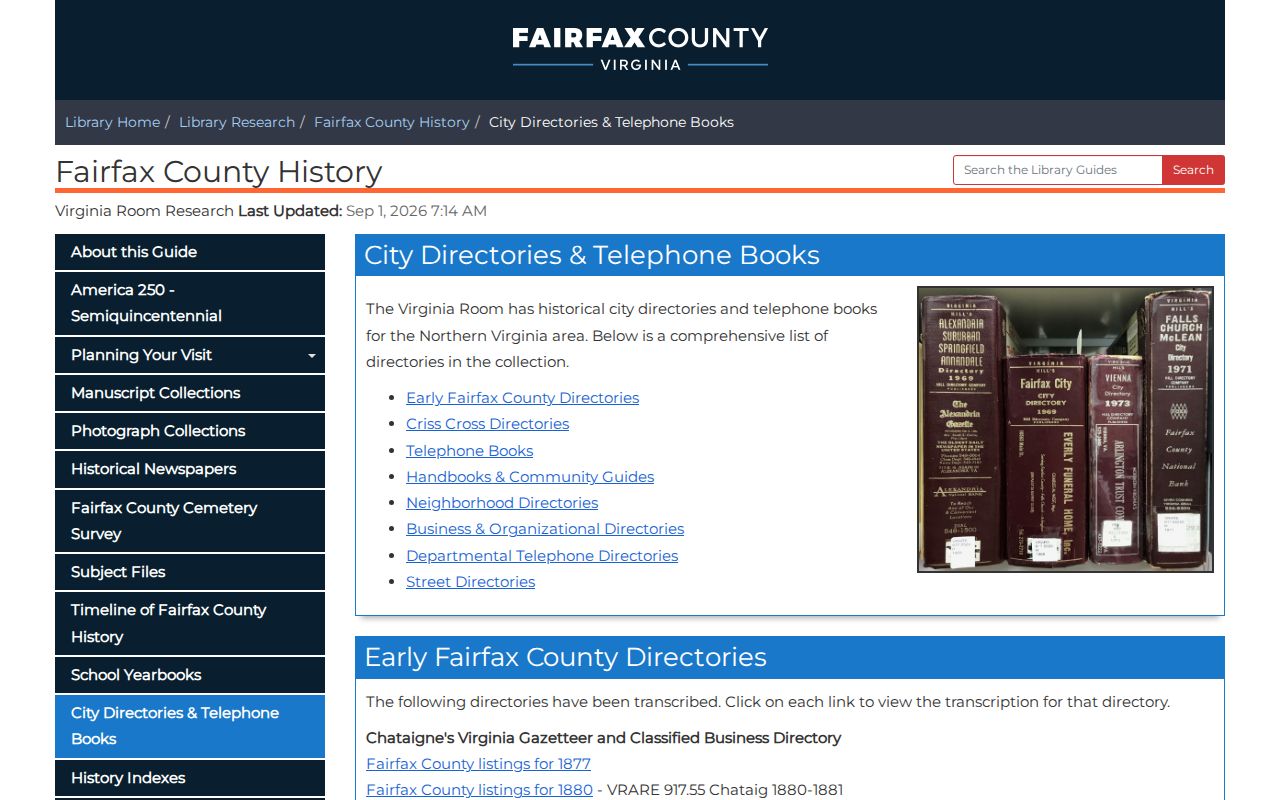
The holdings display helps you pick the right publisher and run before a visit, but each individual volume remains the authority for its own entries and abbreviations.
Rose Hill Directories After 1965
In 1965 Fairfax County changed 400 duplicate street names. The county also renumbered nearly every house into an E911-style system. That single event is the hinge for postwar Rose Hill directory work. A telephone-book entry or reverse-directory number from before the change may not match the modern situs number. Keep the old figure. But never search it as though the number stayed fixed. Bridge the change with old road names, cross streets, subdivision names, parcel legal descriptions, tax maps, and deed references. The county's property-history guidance recommends pairing these sources instead of trusting one address form. A legal description is often the steadier link, since it can survive a renumbering. Once the historical match is made, the Rose Hill Street Directory carries the current street-by-street record trail. Note: Compare several years on each side of 1965, because a directory's publication cycle and the county renumbering did not necessarily align.
Trace Rose Hill Directory Households
Start with one address and one year. That anchor makes every later step easier. A criss-cross book or telephone directory can name the occupant or subscriber tied to the number, and that name then opens the standard city directory for the same period. Whatever the listing says, test it against a newspaper index, a deed index, voter rolls, a yearbook, or a census record suited to the era. A name that vanishes between volumes is rarely a verdict. It may signal a move, a death, an unlisted number, or an editor's change, so treat it as a cue to check another source.
- Record the address, the volume year, the exact spelling, and every printed abbreviation from the first entry.
- Check the same person in adjacent directory or telephone-book years, noting each address and affiliation change.
- Use a criss-cross section for the address, then compare nearby listings only as historical context rather than a full household roll.
- Pair directory periods with released federal census schedules, available through 1950, to test household composition at the census date.
- For a later event, consult the Virginia Room newspaper index, probate material, or a yearbook as an independent follow-up source.
Newspapers fill the gaps that printed listings leave. The Virginia Room's Historical Newspaper Index holds more than one million records drawn from ten local papers. Its documented tip for property questions is simple. Search a surname together with the word "house" across the whole subject field. Obituaries and probate filings reached this way can surface a spouse, children, an executor, heirs, or a former address. They can also point to a former address. Each claim still deserves a check in its own source before it counts as settled.
Rose Hill Yearbooks and Memory
Directories say little about classmates and teenagers. People with unlisted numbers barely appear at all. The Virginia Room compensates with nearly 500 physical school yearbooks. Since 2016 Fairfax County Public Library has scanned more than 300 Fairfax County Public Schools yearbooks from 36 schools into a free, keyword-searchable Internet Archive collection. The room's photographic archive adds more than 13,400 images on top of that. For a Rose Hill family-history question, search by school. Search by graduation year, surname, team, club, and neighborhood too. A caption can point to the right directory period. Then test the address and date in the matching printed source. This works well for reconnecting with a former classmate. It also builds community history. It does so without pretending a single directory listing is a complete personal profile.
Rose Hill Directory Endpoints
A historical search does not always end in a city directory. Sometimes the answer is a burial place, a property story, or a newspaper notice. The Fairfax cemetery inventory serves as a countywide companion source for exactly those cases. It documents more than 350 individual cemeteries. The inventory expands a 1977 transcription project that covered roughly 100 sites. Entries may carry a location, coordinates, tax map or parcel details, ownership or caretaker, condition notes. Some even include a headstone transcription.
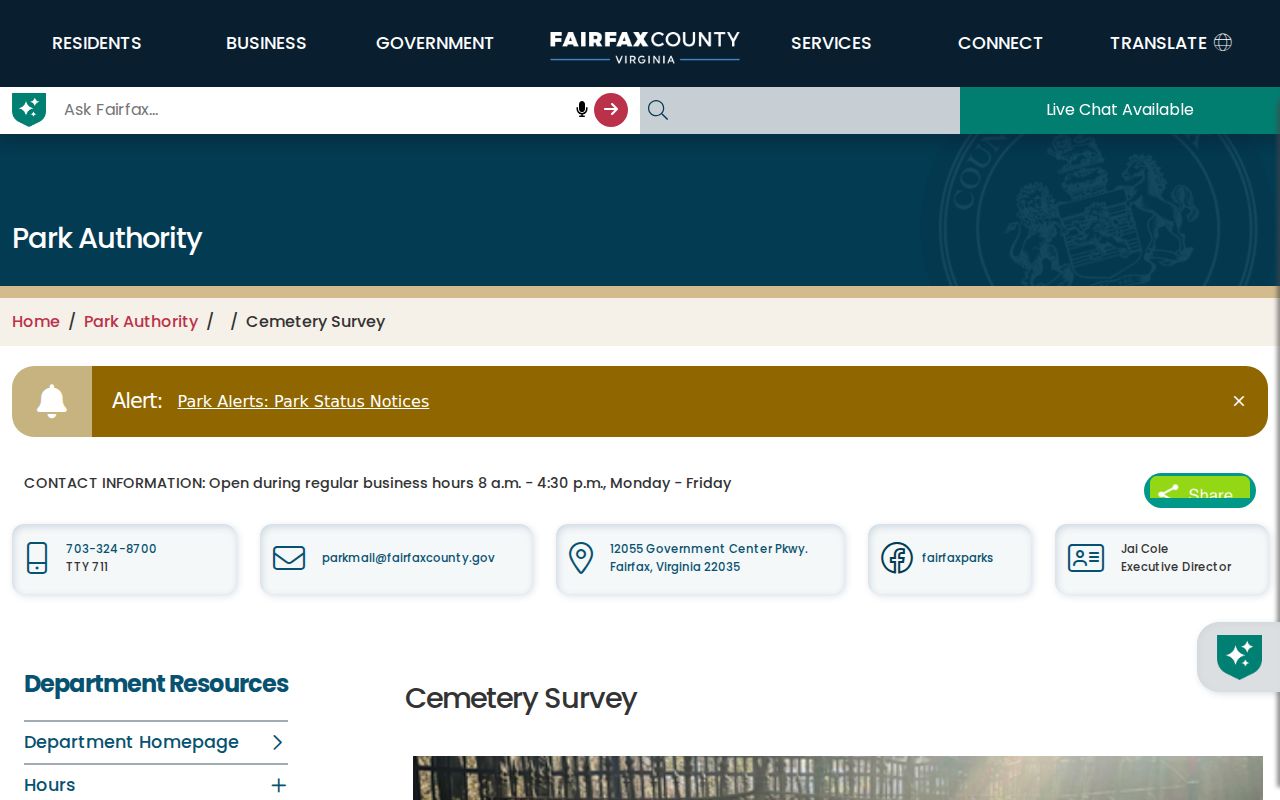
The inventory offers no universal live interment search. Use it to identify a likely place record, then confirm any person-specific conclusion with the documented custodian or the holding collection.
Rose Hill Historical Collections
When a published listing falls short, the reading room is the next stop. The Historical Society of Fairfax County collection, cataloged as MSS 05-01, covers 1946 through 2016. It sits in the Virginia Room. Its finding aid points to membership lists and applications. It also lists meetings, genealogy requests, local history files, photographs, and yearbooks. ARVAS reports no online items for the collection. So the route runs through the catalog, a librarian or archivist, and an in-person visit. Fairfax HRC widens the record landscape further. It holds older voting records, road materials, Civil War pensions, school records and ledgers, and sheriff executions. None of these are Rose Hill-specific city directories. They can still pin down a date, a road, or a family tie. That detail may explain why a name first shows up in a later regional listing. Record each source title and date exactly. That discipline matters most where initials and married names shift between volumes.
Rose Hill Directory Timeline
The timeline runs from the earliest printed volumes to modern local-history collections. Order matters here. Early Fairfax material demands a county-wide lens, while mid-century and later regional runs grow steadily more useful for a specific Rose Hill address.
| 1877-1897 | Chataigne's Fairfax listings appear in six verified years, well before Rose Hill's modern neighborhood identity. |
|---|---|
| 1906-1911 | Hill's Fairfax gazetteer listings and the 1906 Fairfax County directory provide county and business context. |
| 1938-1980 | Listed Alexandria City Hill's criss-cross runs supply regional address-to-occupant context for Alexandria mailing areas. |
| 1954 | Rose Hill's modern neighborhood identity is created. |
| 1965 | Fairfax changes duplicate street names and renumbers almost every house, creating a crucial address bridge. |
| 1962-2018 | Northern Virginia and Washington Metro White Pages offer subscriber and address continuity clues. |
Treat the dates as a routing aid. They are not proof of continuous coverage. Publication gaps, shifting geographic scope, and changing address systems all mean a volume should be compared against county-held land and address sources before you trust it. Note: A directory name match grows stronger when its date, address, spouse notation, occupation, and parcel trail all point to the same person.